Gravitational Lensing

An internship at the data science research organisation Toelt AI has allowed me an intimate view into the physics of gravitational lensing. In conjunction with academic faculty at the University of Milan I have assisted in developing efficient gravitational lensing software written in Julia, which can handle a wide range of strong lensing systems to determine the underlying parameters using Bayesian statistics. Significant study of gravitational lensing was conducted during this time, to supplement the understanding of computational methods.

Find here a link to a presentation giving an overview of the main conceptual topics in gravitational lensing prepared during this internship:
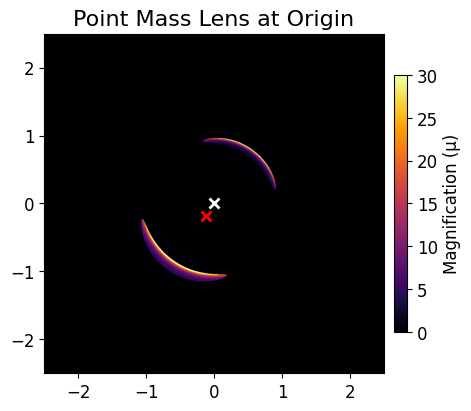
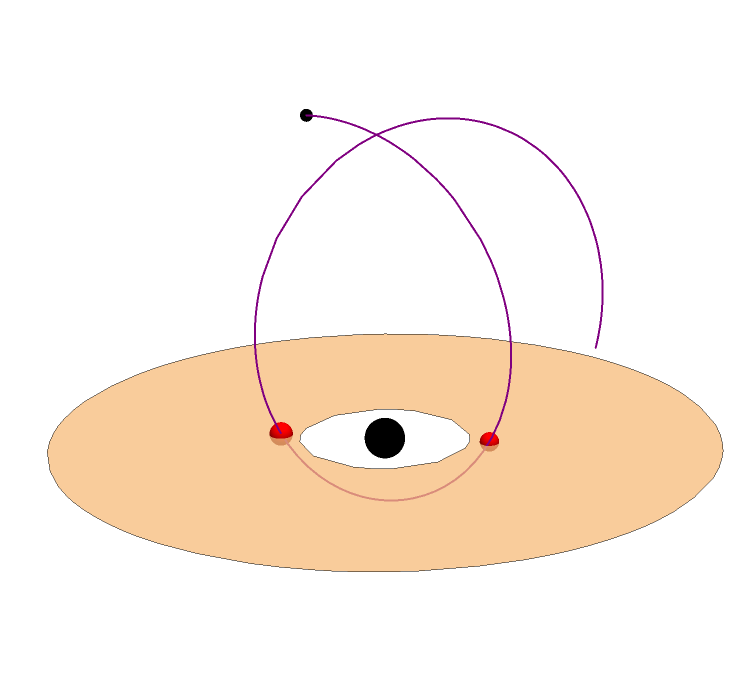
Image example of point mass lensing

Parameter Estimation for the OJ 287 System

My Bachelor's thesis focused on general relativity and examined the OJ 287 supermassive binary black hole system. This system is a BL Lacertae object, a type of active galactic nucleus (AGN) known for its rapid optical variability. This system emits quasi-periodic flashes of light, for which we have historical observations dating back over a hundred years. The secondary black hole orbits around the primary and emits a flash of light when interacting with the accretion disk surrounding the primary black hole. The project aimed to determine the parameters of the system by modelling the orbits, predicting the outbursts of light and comparing with observations. The Bachelor's thesis represents an initial assessment and prediction, while a consequential summer internship extended the methodology and improved the result accuracy with uncertainties on the parameters.

Linked here is my Bachelor's thesis and the summer internship report:

Image of a binary black hole

Approximate Bayesian Computing (ABC)

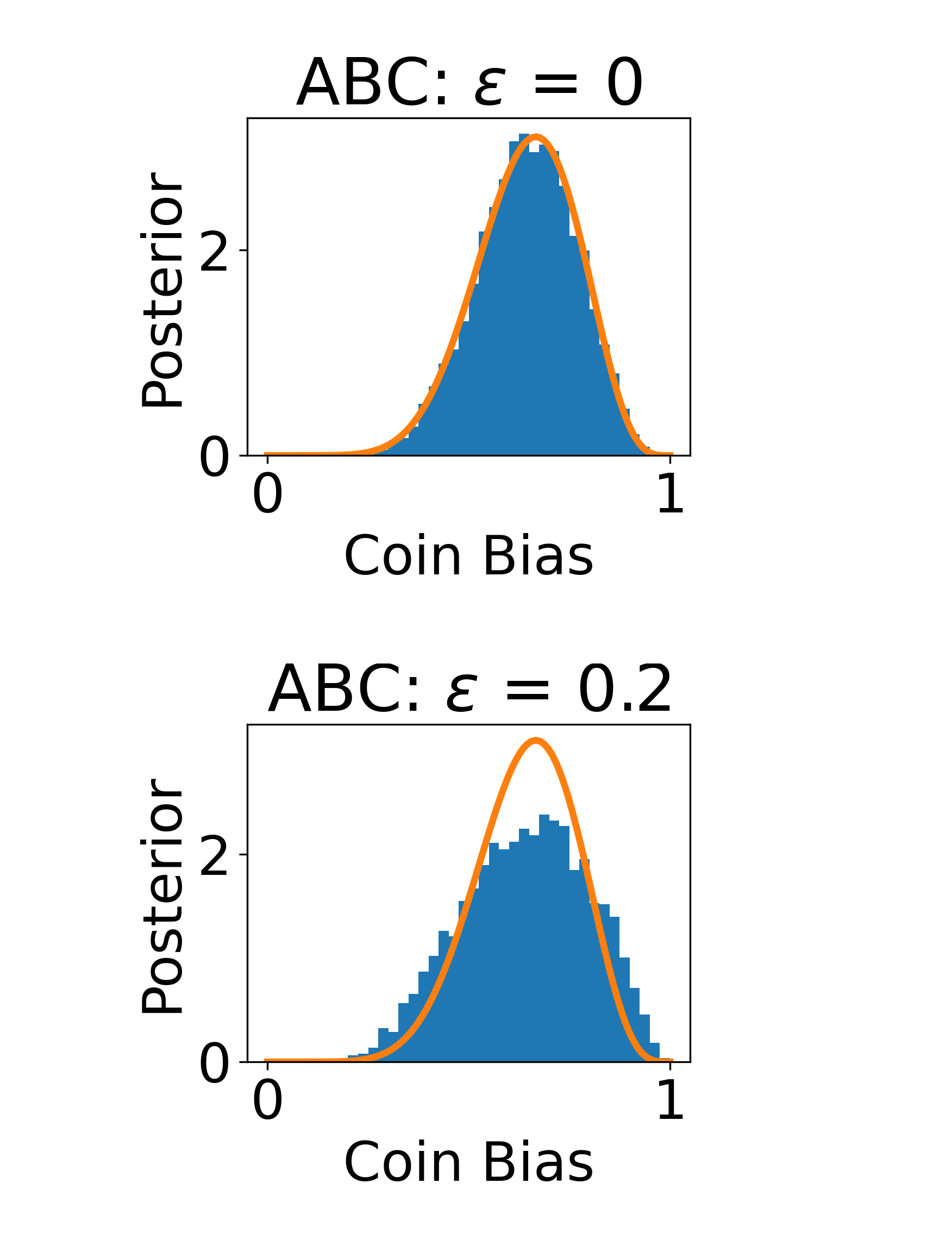
During my studies at ETH Zürich I conducted a course in Bayesian Statistics and Data Analysis. Students were required to select and independently research a topic within the field. I chose to research Approximate Bayesian Computing (ABC). In classical Bayesian statistics, the posterior distribution is equal to the product of a likelihood function multiplied by a prior distribution and divided by the evidence, a marginalisation factor. Often it is difficult to find a tractable analytic solution to the likelihood function. ABC bypasses the need for a likelihood function by synthetically generating data, with which the posterior can be found.

Linked here is the report for this course, where I investigated both discrete and continuous data spaces:

Posterior of biased coin with ABC

Effect of Stellar Mass and Orbital Radius on Giant Planet Formation

I conducted my Master's thesis in the field of planetary formation, specifically investigating the effect of host star mass and orbital distance on the gas accretion and growth of gas giant planets. Recent exoplanet observations show a large range of giant planets found, which indicate a great magnitude of them in our universe. Formation models, however, often neglect the effects of the stellar system in the formation of giant planets. My thesis aimed to determine new forms of fitting equations used in predicting gas accretion rates, then to use these alongside solid accretion rates to investigate the environmental effects in giant planet formation.

My Master's thesis is linked here, overviewing my research efforts of gas giant planet formation:

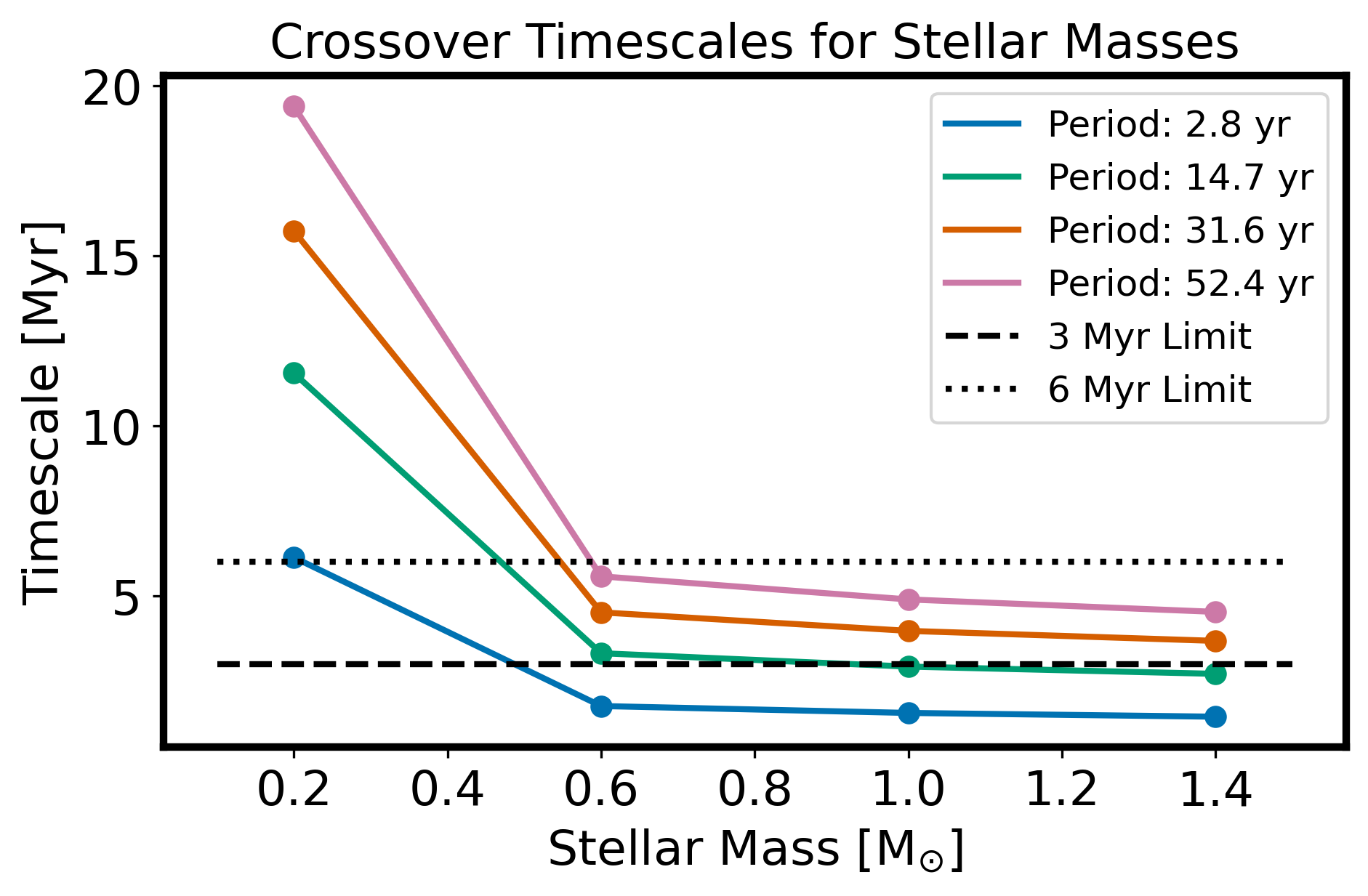
Plot of giant planet formation times